
How To Build Your Corporate Exit
TL;DR: The best corporate exits are built from the inside, not the outside. Senior leaders who wait until they leave to start building are starting from zero. The strategy is to use your current role as leverage — income, credibility, access, and relationships — to build your advisory business while you're still employed, then make the transition when the income is there to support it.
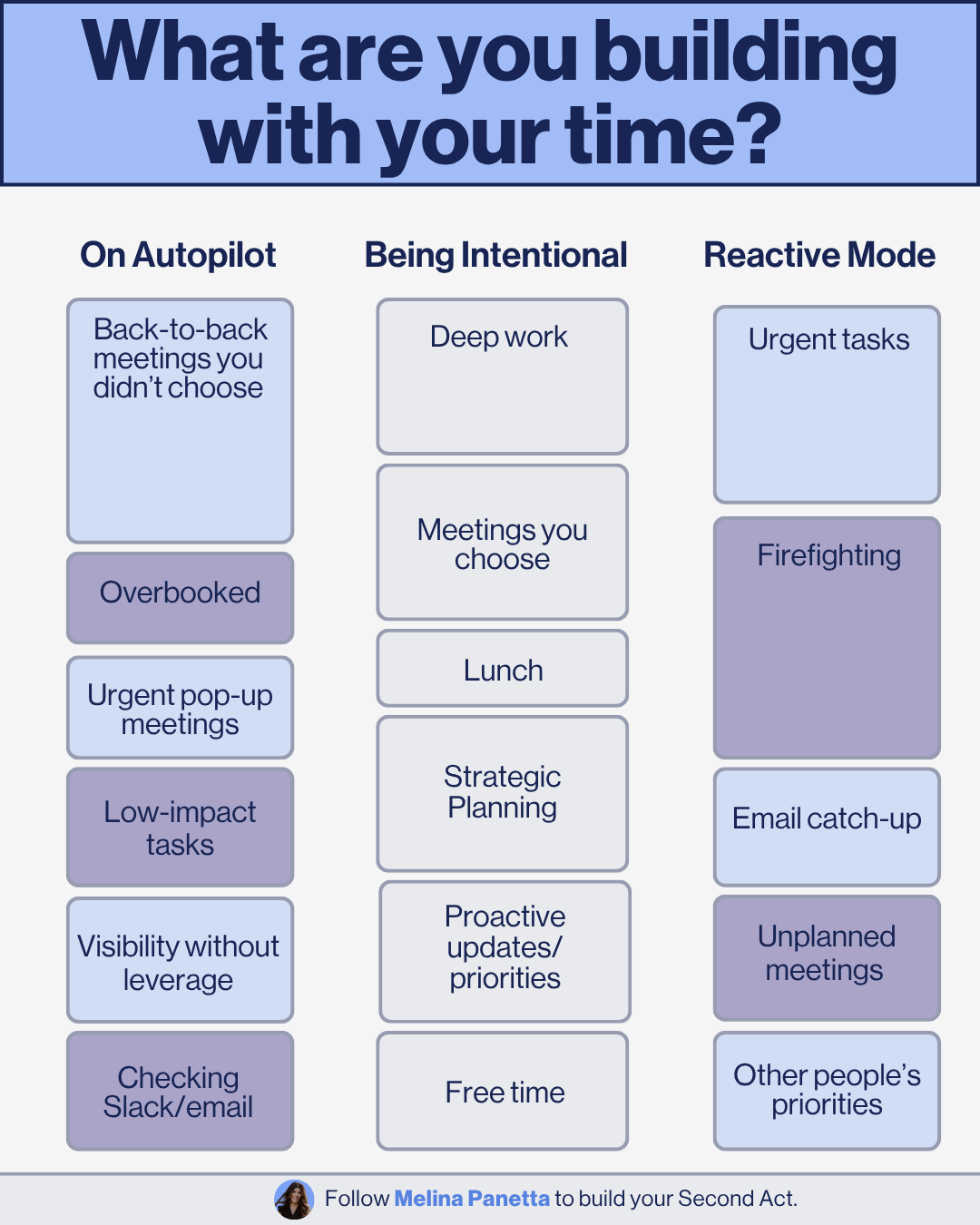
"I don't have time to build a business while working full-time."
I hear this constantly from burned-out VPs and Directors who want out of corporate but feel trapped.
They think they need 10 hours a week, a fully formed business plan, or endless energy after a 12-hour workday.
So they stay stuck and keep telling themselves "someday" or "when things slow down."
But things never slow down in corporate.
Trust me, it doesn’t take 10 hours a week to begin with.
You can start with 30 minutes a day, as long as you protect those 30 minutes like your future depends on it.
Because it does.
Today, I'm walking you through exactly how to create capacity and what to work on during that time so you can build a seamless exit.
Why 30 minutes is enough (and why more isn’t better yet)
When I tell people they can build their advisory business in 30 minutes a day, they don't believe me.
They think I'm sugarcoating it or that I got lucky.
But I built mine for three years while working full-time, with 30 focused minutes every single day before work.
People overestimate what they need to start.
They think building a business requires massive blocks of uninterrupted time.
But the truth is, you're not building a full-scale operation yet.
When you’re starting out, you're validating an idea, mapping your network, clarifying your positioning, and testing demand.
All of that can happen in 30-minute increments.
The key word is focused.
Not 30 minutes with Slack open on another screen.
Not 30 minutes checking email between tasks.
Real, deep work where you shut everything else out and make progress on one thing.
If you can do that consistently, something happens after about 10 to 14 days.
You look up and realize an hour has passed.
You lose track of time because you're seeing traction.
Your brain stops resisting and starts craving the work.
That 30 minutes naturally expands to 35, then 40, then more.
But you can't skip the first two weeks.
You have to earn that momentum.
The focused 30-minute rule (no exceptions)
Your 30 minutes can't be whenever you "find time."
You have to claim it. Put it on your calendar.
Protect it and treat it like a client meeting you can't move.
For me, it was 7 a.m. before anyone else was awake.
For you, it might be 10 p.m. after the kids are asleep or during your lunch break at a coffee shop away from your desk.
The time doesn't matter.
The consistency does.
And it has to be focused.
Close your email.
Turn off Slack.
Silence your phone.
If you're half-in and half-out, you're wasting your time.
You'll spend those 30 minutes spinning your wheels and convince yourself it's not working.
What to work on first (your hierarchy for the first 30 days)
If you only have 30 minutes a day, you can't waste time on the wrong things.
Forget the logo.
Forget the website.
Forget picking a color palette for your brand. None of that matters yet.
Start with this.
Week 1-2: Identify your unique expertise angle
Your angle is the specific problem you solve, for whom, and what makes your approach different.
Spend your 30 minutes writing down every problem you solve at work.
Then narrow it to one problem that's urgent, expensive, and recurring for a specific type of client.
That's your starting point.
Week 3: Build your story and credibility
Once you know the problem you solve, you need proof that you can solve it.
What results have you delivered before?
What case studies can you pull from your corporate experience?
What's the story behind why you're uniquely qualified to solve this problem?
Write it down. This becomes your 5-minute pitch and eventually your 30-second version.
Week 4: Map your existing network
You don't need to cold-pitch strangers on LinkedIn. You have a network.
Spend your 30 minutes listing everyone you've worked with, including colleagues, clients, vendors, and industry contacts.
Categorize them and identify the warm contacts who might need your help or know someone who does.
This is how most people land their first client.
What comes after the first 30 days
Once you've done the foundational work, the focus of your 30 minutes moves to visibility and validation.
You start showing up on LinkedIn in a way that doesn't raise red flags at your employer.
You have coffee chats to test your positioning and pricing. You refine your offer based on real feedback.
This creates opportunities to land a pilot client.
You negotiate a scope of work that doesn't conflict with your day job.
Then, you use that pilot as proof for your next clients.
And then you keep building.
Two clients. Three clients.
A pricing structure that can replace your salary within six clients.
All of this starts with 30 minutes.
The mistake most people make
They wait until they have more time.
Until things slow down.
Until the pressure eases.
But corporate never slows down.
The pressure never eases.
You get promoted and the workload increases.
You prove you're capable and they pile on more responsibility.
If you wait for permission or the perfect moment, you'll be waiting forever.
30 minutes is enough. You just have to start.
Need help creating your 4-week pilot strategy?
Send me a message with “Pilot” and we can arrange a time to map this out together.
Melina
Frequently Asked Questions
When should I start building my corporate exit? The best time to start is while you are still employed. Your corporate role gives you income stability, credibility, and access to relationships you can use to build an advisory client base. Waiting until after you leave means starting without leverage.
Do I need a business plan before I start? No. You need clarity on the problem you solve, the audience you serve, and your first offer. A full business plan creates the illusion of preparation without moving you forward. Start with those three things and refine as you go.
How long does it take to build a corporate exit? Most senior leaders who follow a structured approach can build to their first advisory client within 45 to 90 days and replace a meaningful portion of their income within six to twelve months. The timeline depends on how clearly you can articulate your offer and how actively you build your pipeline.
What if I am not sure what my advisory offer should be? Start with the problem you have solved most consistently across your career — the one people came to you for before they came to anyone else. That pattern is usually the foundation of your strongest offer. You do not need to build something new. You need to package what you already know.
Is it possible to build an exit without anyone at work finding out? Yes. Most senior leaders who build through The Modern Founder Method do so quietly, using LinkedIn and direct outreach to build a pipeline before making any public announcement about their transition.