
How to Price Your Advisory Services as a Former Corporate Executive
By Melina Panetta | Executive Advisor | Last updated: July 2026
TL;DR: Most senior corporate leaders underprice their advisory services by anchoring to their salary or an hourly rate. Advisory pricing works differently — it's based on the value of your judgment, not the hours you spend. Senior-level advisors typically charge $8,000–$15,000 per client per month on retainer. Two to three clients can replace a multiple six-figure corporate salary.
You spent 20 years making decisions that moved millions of dollars. Now you're trying to figure out what to charge per hour.
That's the wrong math.
Advisory pricing isn't built on time. It's built on the value of what you know, what you've seen, and what your clients avoid by hiring you. When you get this right, the income is there. When you get it wrong, you build a business that feels like a second job.
This guide walks through how advisory pricing actually works, the three mistakes that cause senior leaders to leave money on the table, and how to build a pricing structure that reflects what you're actually worth.
Why Corporate Leaders Underprice Their Advisory Services
There are two pricing instincts that come directly from corporate life — and both work against you as an advisor.
The salary instinct. You know what you made. You know what your time was worth inside a company. So when you go independent, you divide your annual salary by 2,000 hours and land on an hourly rate. The problem: your salary was the price a company paid for all of your time, including the meetings, the emails, the bureaucracy, and everything that had nothing to do with your actual judgment. Advisory work is only the judgment part. The rate has to reflect that.
The prove-it instinct. Corporate rewards visible effort. You were promoted for doing more, delivering faster, staying later. That wiring follows you into advisory — and it pushes you to charge less, take on more, and demonstrate your value through output rather than outcomes. Clients don't hire advisors to see effort. They hire advisors to get results.
Both instincts feel responsible. Neither serves you or your clients.
The Three Pricing Mistakes Senior Leaders Make
1. Charging by the hour. Hourly pricing caps your income and misrepresents your value. If a client knows the meter is running, they ration their questions. If you answer quickly — because you've solved this problem twenty times — you get paid less for being better. Hourly pricing punishes expertise.
2. Starting low to "build trust." Starting low is a positioning mistake, not a generosity one. The price signals the level. When you charge a fraction of what a senior engagement is worth, you attract clients who aren't a fit for senior-level advisory work, and you create a ceiling that's hard to raise later. The right price filters the right clients in.
3. Pricing one engagement at a time. If every client negotiates a custom number from scratch, you have no business — you have a series of deals. Advisory pricing needs a structure: defined tiers, defined scope, defined terms. Without it, you're constantly selling instead of advising.
How Advisory Retainer Pricing Works
Advisory retainers are the core revenue model for independent advisors. A client pays a fixed monthly fee for access to your thinking, your judgment, and your time — on a defined basis. They get strategic guidance when they need it. You get recurring, predictable income.
Retainers for senior-level advisors typically fall in this range:
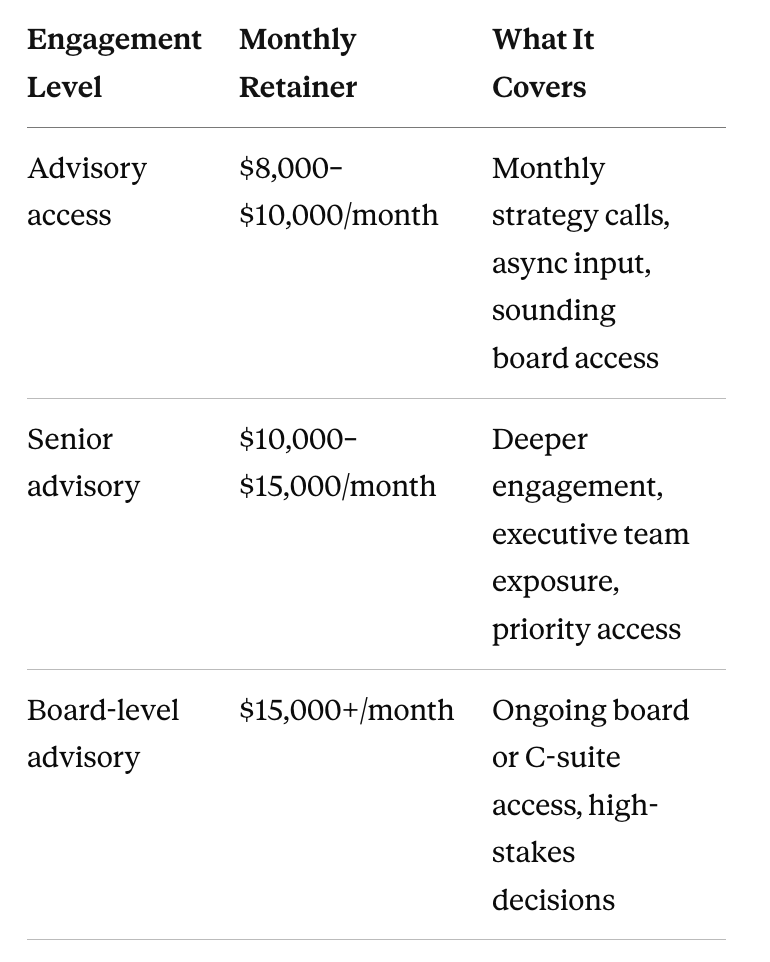
The right tier depends on two things: your positioning and your client's problem size. A VP of Operations helping a $20M company scale is solving a different problem than a former CFO advising a pre-IPO company on capital structure. Price the engagement to match the stakes.
Build a Three-Tier Offer Structure
A three-tier structure gives clients options, reduces friction in the sales conversation, and protects your most valuable time for clients who pay for it.
Tier 1 — Entry advisory. Your lowest commitment option. Typically one call per month plus async access. Priced to be accessible to leaders who are serious but early-stage. Sets the floor.
Tier 2 — Core advisory. Your primary offer. More access, deeper engagement, defined outcomes. This is where most of your clients should land, and it should be priced at the center of your retainer range.
Tier 3 — Priority advisory. Reserved for clients who need you most available and most involved. Highest access, highest fee. This tier exists to protect Tiers 1 and 2 by capturing the clients who would otherwise take all your time at the lower rate.
Price each tier so that Tier 2 is clearly the value option. Most clients will choose it. Tier 1 exists for the right entry clients. Tier 3 exists to anchor the range and justify Tier 2.
What Your First Advisory Engagement Should Cost
Most senior leaders set their first rate too low, raise it too slowly, and spend years catching up to what they should have charged from the start.
A better approach: price your first engagement at what you'd need to charge to want to do the work. Not the floor you can defend. The number that makes you want to show up. Then test it in real conversations.
If every potential client says yes immediately, you're underpriced. If no one engages, you may be priced ahead of your current positioning. The market tells you — but you have to start with a number worth finding out about.
For most senior leaders with 20+ years of Fortune 500 experience, $8,000–$10,000 per month is the right starting point for a core retainer. That's not aggressive. That's the floor for senior-level advisory work.
The Confidence Problem
Pricing isn't a math problem. It's a positioning problem with a confidence layer on top.
Most senior leaders know their work is worth more than they're charging. The hesitation isn't about the market. It's about the moment when someone asks, "What do you charge?" and you have to say the number out loud.
The way through it: say the number before you're ready. Practice it. Get it out of your head and into conversations. Every time you say it without apologizing or hedging, it gets easier. Every time you lower it preemptively, you make it harder.
The leaders who build premium advisory businesses don't have a pricing formula that other advisors lack. They decided to stop underpricing themselves and held the line long enough to find clients who agreed.
The Modern Founder Method™
Pricing is one of four phases in The Modern Founder Method™ — the 10-week framework built for senior corporate leaders who want to build a premium advisory business without quitting first.
Phase 2 of the method is built entirely around offer design and pricing: mapping your buyers, defining your premium offer, and pricing from value rather than fear. The goal isn't a rate card. It's a pricing structure you can defend, sell, and build a business on.
125+ senior leaders from companies including Workday, Oracle, HP, Stryker, Amazon Web Services, Goldman Sachs, and Yahoo have used this framework to build advisory businesses while still employed.
Where to Start
If you're building an advisory business and haven't set your pricing yet, start here:
Pick a retainer number in the $8,000–$10,000 range and say it in three conversations this week. Not as a final offer — as a starting point for a real market conversation. See what happens.
Most senior leaders discover that the market is less resistant than the internal voice that convinced them to charge less.
If you want a structured path through offer design, pricing, and client acquisition — built specifically for leaders transitioning from corporate — explore The Modern Founder Method™.
Explore The Modern Founder Method™ →
Every week, The Bridge delivers strategies for senior corporate leaders building a premium advisory business — including pricing frameworks, positioning, and client acquisition.
Join 1,600+ leaders reading The Bridge →
Frequently Asked Questions
What should I charge for advisory services? Senior corporate leaders with 20+ years of experience typically charge $8,000–$15,000 per client per month for advisory retainers. The right number depends on your positioning, your client's problem size, and what your engagement includes.
Should I charge hourly or on retainer for advisory work? Retainer. Hourly pricing punishes expertise — the faster you solve a problem, the less you earn. A retainer reflects your ongoing value and creates predictable income for both sides.
How do I know if I'm underpricing my advisory services? If every prospect says yes immediately, you're underpriced. If you feel relief when a client agrees to your rate, you're probably underpriced. The right price creates a small amount of tension — not enough to lose the right clients, enough to filter out the wrong ones.
How many advisory clients can I handle? Most senior advisors work with three to six retainer clients simultaneously. Advisory doesn't require execution, so you're not constrained the way a fractional executive would be. Your capacity depends on access level — more intensive engagements mean fewer clients.
What's the difference between advisory pricing and consulting pricing? Consulting is typically project-based and billed by the deliverable or the hour. Advisory pricing is ongoing, retainer-based, and reflects the value of your judgment rather than the time you spend. Advisory scales better because it isn't tied to how much you work.
Can I raise my rates after I've started with a client? Yes. Build rate review into the engagement terms from the start — annually, or at a defined renewal point. Clients who value your work expect rates to reflect your growing impact. The ones who push back hard at renewal are often the wrong fit for long-term advisory relationships.
Melina Panetta is an executive advisor who helps senior corporate leaders turn 20+ years of expertise into a premium advisory business through The Modern Founder Method™. She has worked with 125+ senior leaders from Fortune 500 companies including Workday, Oracle, HP, Stryker, Amazon Web Services, Goldman Sachs, and Yahoo. She writes The Bridge, a weekly newsletter read by 1,600+ senior leaders.